Building capacity in community-based participatory research for transformative learning
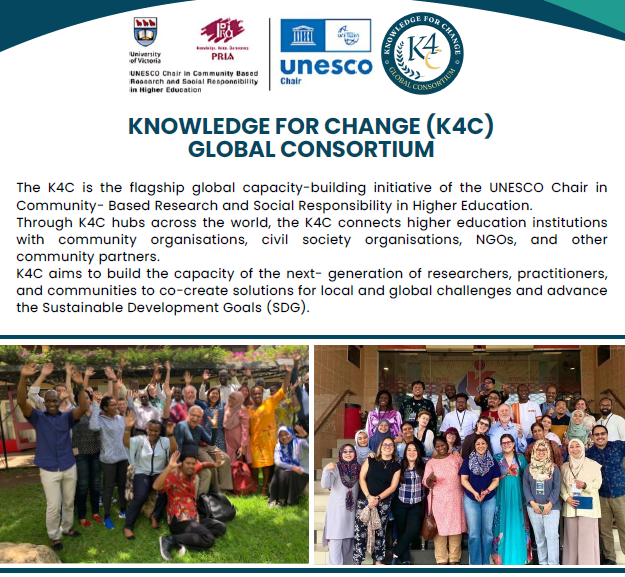
The UNESCO Chair CBRSRHE formally turned towards training and capacity building for community-based participatory research (CBPR) during its second term (2016–2020) with the creation of the Knowledge for Change Global Consortium.
Knowledge For Change (K4C) Global Consortium on Training for Community-Based Research (CBR)
The K4C Consortium was formally launched during November 2017, in New Delhi, India, in collaboration with the UNESCO New Delhi Office and the Indian Association for Universities. This was closely followed by its Canadian launch the next month, with joint efforts from the University of Victoria and the Canadian Commission for UNESCO.
The resultant K4C hubs were the answer to sustainable structures for building research capacity in CBPR through formal partnerships between universities and communities or practitioner organisations, highlighting training through hands-on CBR linked to the UN SDGs. The K4C model focuses on capacity building through a Mentor Training Program (MTP). Academics from higher education institutions and practitioners from civil society organisations (are trained as mentors to advance the socially responsible research agenda at the university level.
During its third term (2020-2024), the Chair’s K4C consortium expanded as more hubs were added. Various policy changes in the higher education sector also mandated CBR training for faculty. In India, for example, the University Grants Commission (UGC) mandated CBPR training for faculty, in consultation with the UNESCO Chair. During this period, the Chair also led projects, such as the Bridging Knowledge Culture project, to support researchers and universities transition towards knowledge co-creation.
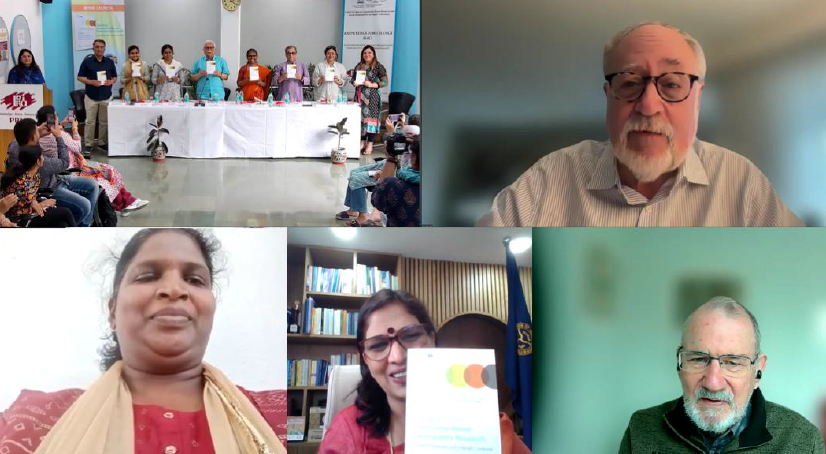
The Chair’s K4C consortium conducted a comprehensive project on training academics in community-based participatory research during 2017-2022. This involved 12 K4C hubs across nine countries. The project culminated in a book, Bridging Knowledge Cultures: Rebalancing Power in the Co-Construction of Knowledge (2023), which was closely followed by a training guide, Bridging Knowledge Cultures: A guide for community practitioner and community organisations .
In its fourth term (2024-2028), the Chair plans to expand its training function by adding more hubs and training 5,000 next-generation scholars across 25 countries by 2028.